The plan was simple. Walk to the lake before breakfast, see the fruit trees flowering along the path, and be back before the sun climbed too high. What we did not plan for was how wide the water would be when we finally stood at the edge of it.
We came from a family gathering in Barangay Mabuhay II in Socorro, Oriental Mindoro. My brother Nixon, our in-law relatives who live in the barangay, and I had spent the previous evening in celebration. The Wedding of Lyka and Aries that brought us all to Mindoro was done. The morning belonged to us, and someone said there was a path to Naujan Lake that started practically from the front of the house.
There was. And it was a good path to take.
The Walk from Mabuhay II to Naujan Lake
The route from Barangay Mabuhay II to the shore of Naujan Lake is direct. No complicated turns, no guesswork. Our in-law relatives knew it well, which meant we moved without stopping to ask anyone for directions. The path takes you through a working farm where rambutan trees were heavy with flowers, their small cream-colored clusters covering the branches in the way that signals fruit is a few weeks away. Banana trees line stretches on the trail path, and the canopy above carried that particular morning quality where the air is still cool enough to make the walk feel easy.

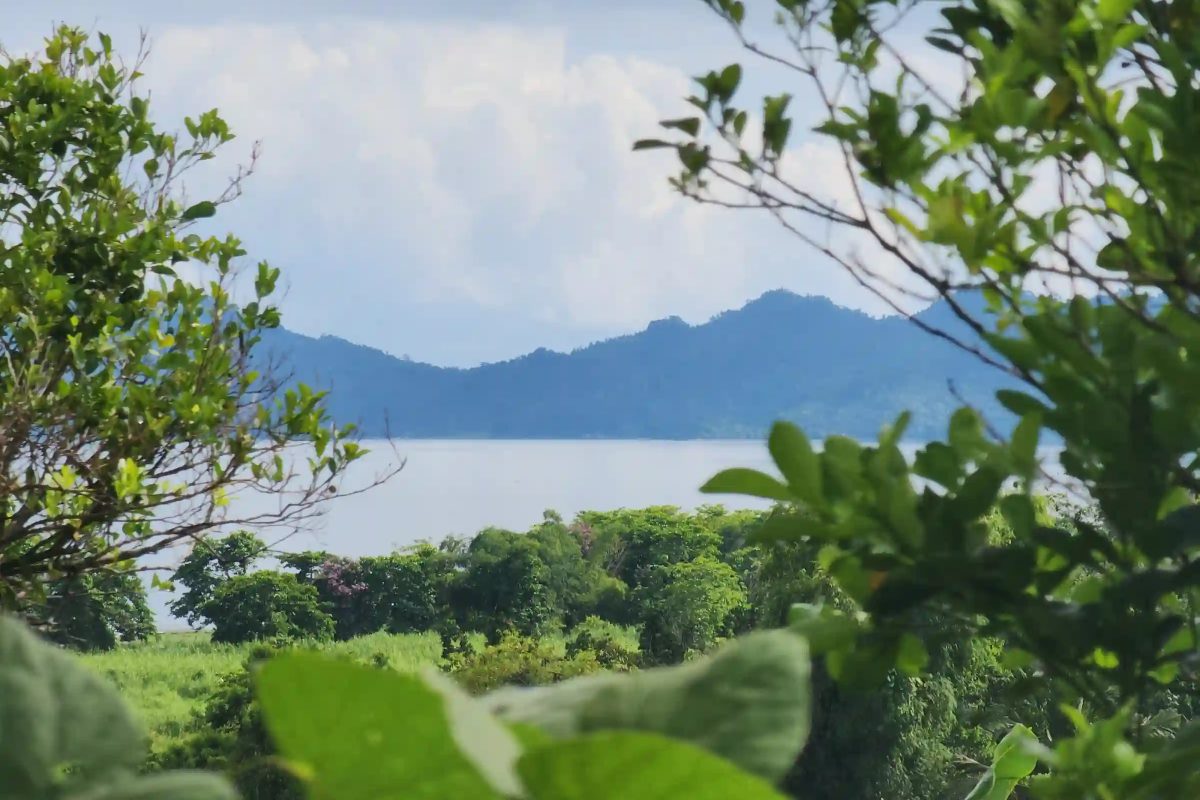
The lake appears before you reach it. From a slightly elevated section of the farm path, you see it through the trees; a wide strip of blue-grey water with mountains on the far side, larger than you expect from that distance. It is one of those moments where the scale of a place registers before you have the full picture, and it keeps growing as you walk the final stretch down to the shore. The walk from the barangay to the water takes roughly 20 to 30 minutes at an easy pace. The path was bulldozed, so the ground is uneven in sections and can be muddy after rain. It is not a hike, and it requires no special footwear. Bring water regardless. The morning heat in Mindoro builds faster than it announces itself, and the return trip will always be warmer than the arrival.
What Naujan Lake Looks Like from the Mabuhay II Shore
Nothing in the walk through the farm prepares you for how much water you see when the path finally opens to the lake.
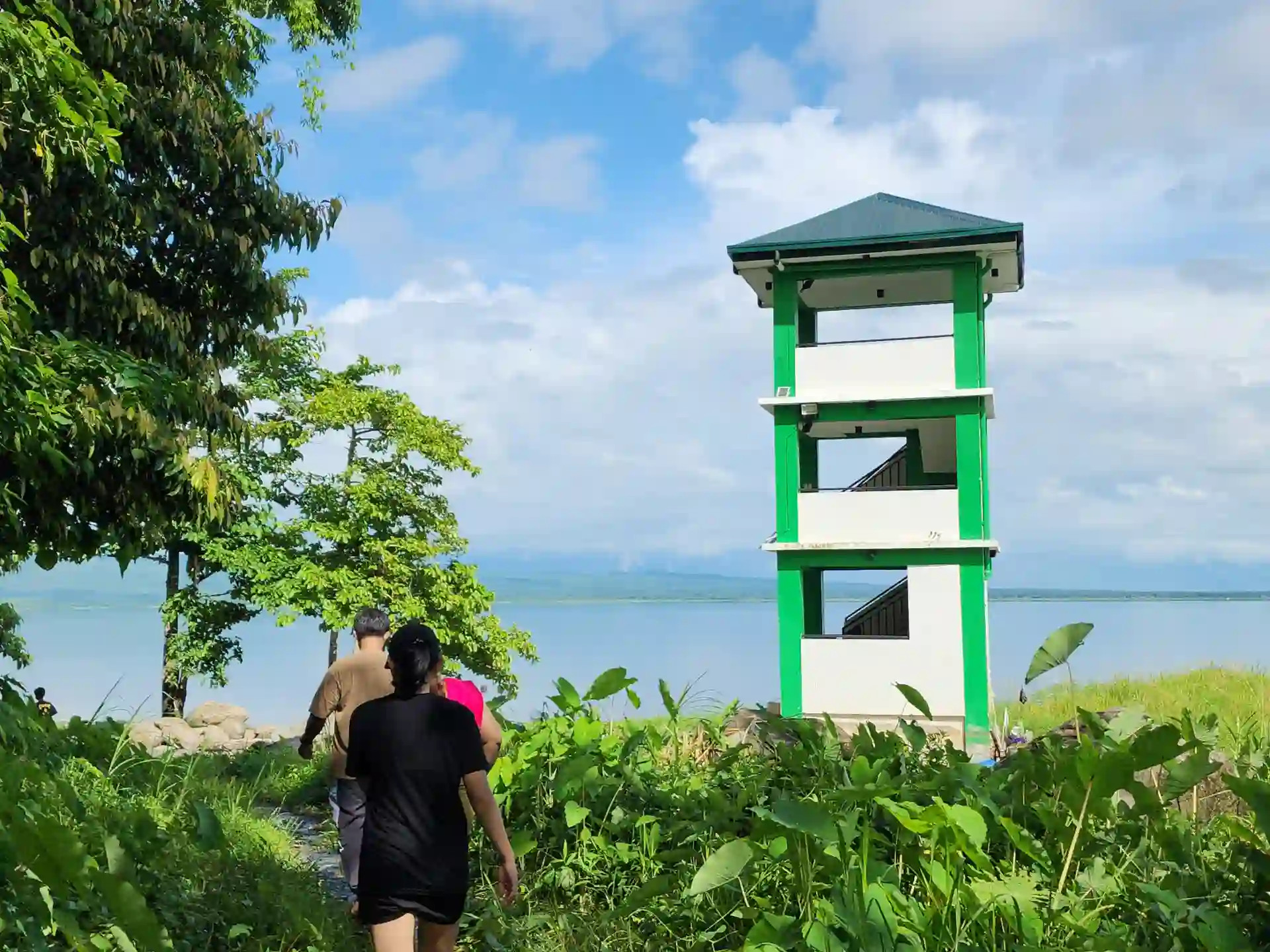
The first structure you reach at the water's edge is a white and green watchtower, three stories high with an open pavilion at the top. It sits at the point where the grassy path gives way to the shore, and it signals that you have arrived at the formal boundary of the Naujan Lake National Park. From the ground beside it, the lake stretches in every direction with the kind of scale that reads as ocean rather than freshwater. The far shore is distant enough that the treeline there blurs into the mountain range behind it.
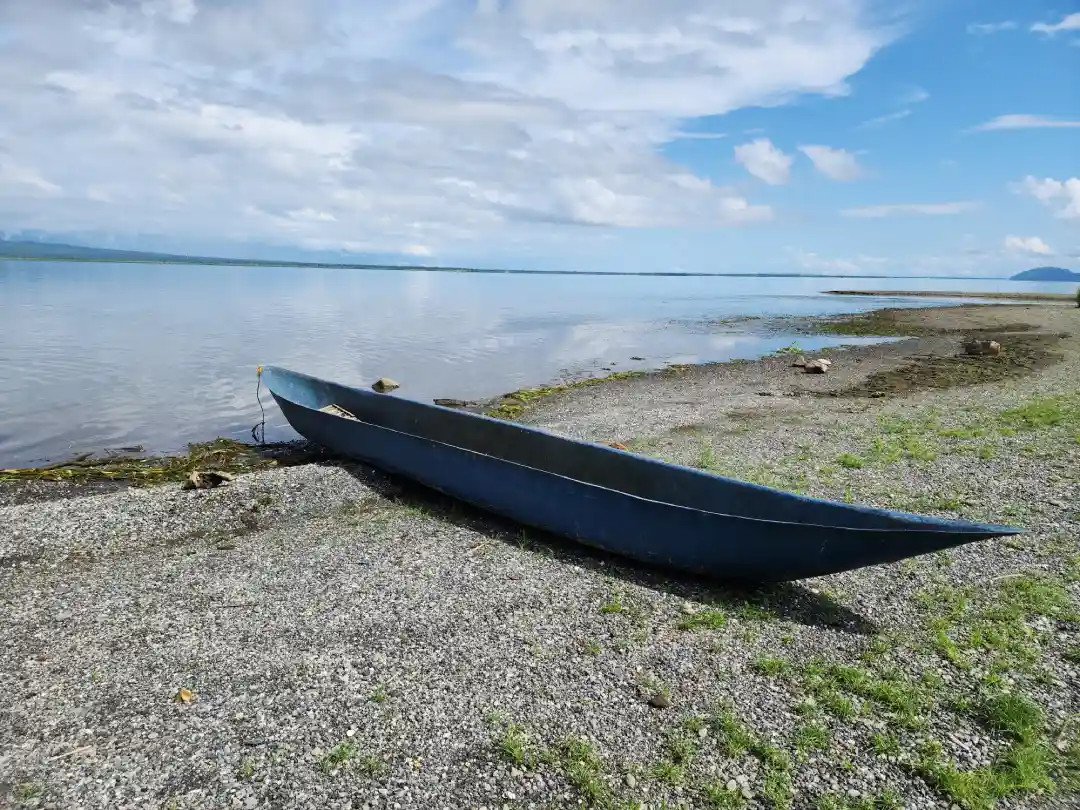
The shore at Mabuhay II is gravel and small rounded stones, not sand. The water at the edge is completely clear, shallow enough close to shore that the lake bed is visible through it, and the clarity holds as it deepens. There is a rocky section to one side where large boulders follow the waterline and green grass grows right up to the stones, and a longer open stretch where the gravel bank runs flat and the water begins without transition.

Naujan Lake is the fifth largest lake in the Philippines, covering 8,125 hectares and running 14 kilometers from north to south at its longest. Bounded by the municipalities of Naujan, Victoria, Pola, and Socorro, it was declared a national park in 1956 and designated a Ramsar Wetland Site in 1999, making it only the second lake in the Philippines to receive that international recognition. What that means on the ground, at the Mabuhay II shore on a May morning, is clean water and working fishermen and a place that does not feel like it has been arranged for visitors.

The Fishermen of Naujan Lake
There were fishermen on the water when we arrived. Small fishing canoe moving slowly near the shore, nets and gear visible in the boats against the flat grey-blue of the lake surface. By the time we had walked the shoreline for a while, we found the landing where a row of canoe sat beached on the gravel, bows pointed toward the water, between runs.
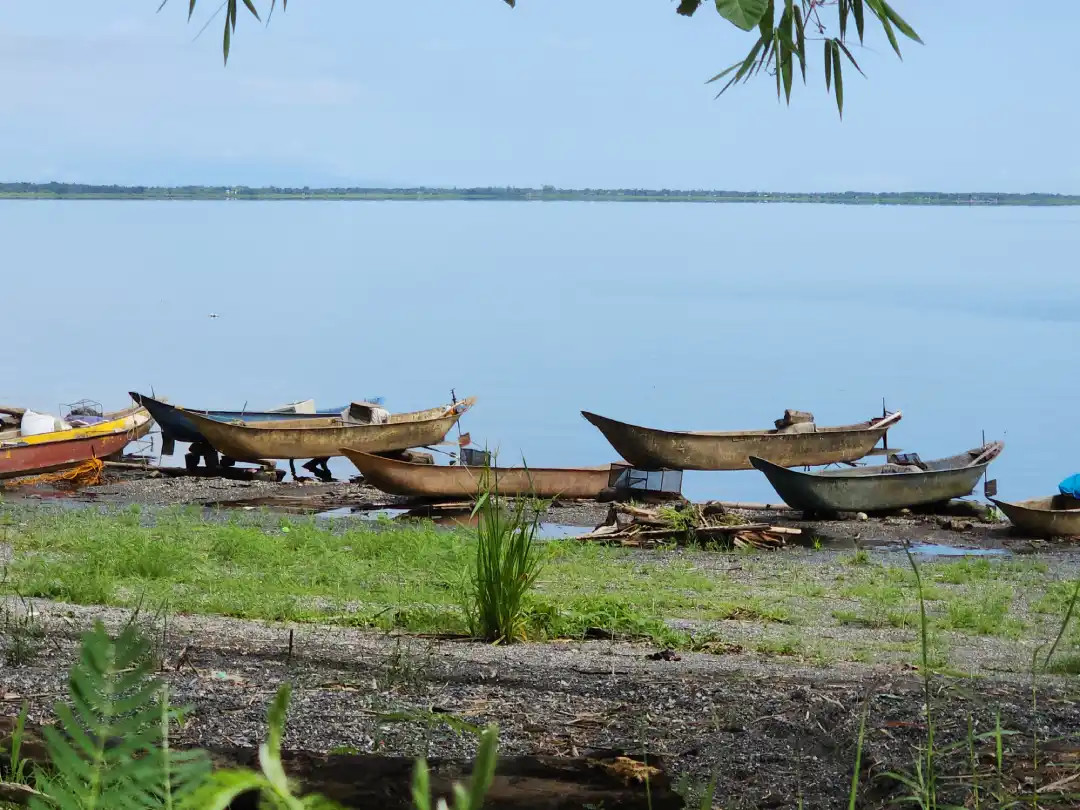
The fishing here is not recreational. These are working boats used by barangay families who depend on the lake daily, and the Mabuhay II shore is a functional landing, not a tourist zone. That is exactly what makes it worth visiting.

One of our in-law relatives, a young pamangkin, waded into the shallows to check a wire mesh fish trap set the night before. He was waist-deep before he reached it, lifting the cage out of the water with the ease of someone who has done the same thing hundreds of times. The lake surface around him was almost completely still, and the ripples from where he stood spread outward in perfect rings across the grey-blue water.

We bought fish from a fisherman who had brought his catch to shore. The fish were fresh, laid out on the flat hull of his canoe. Tilapia and snakehead (dalag), both caught that morning. The transaction was brief. The price was fair without needing to be negotiated. We carried the fish back with us.

Bring cash if you want to buy from the fishermen. There is no fixed market here, no stall, no price list. You approach, you ask, and the price reflects what was caught that morning. Small bills help. The amounts are modest.
What the Path Back Gives You
We left the shore with fish, pako fern gathered along the way, and more mushrooms than we expected to find. Brother Nixon had already held up the largest one for a photograph before we were even halfway back.

The fish, the mushrooms, and the pako were all gathered before we reached the sari-sari store where we stopped to buy cold water. By the time we were home, it was not yet 11 in the morning.
The whole visit, from leaving the house to returning to it, cost nothing except the cash for the fish and the water we bought afterward.
How to Get to Naujan Lake via Barangay Mabuhay II in Socorro
The Mabuhay II access point is barangay-level, not a resort or a formal park entrance. If you are staying with relatives or friends in Socorro who know the area, the route from the barangay to the shore is straightforward and direct.
For visitors coming from outside Socorro:
From Calapan City (the provincial capital of Oriental Mindoro): Ride a UV Express or bus bound south toward Pinamalayan and ask to be dropped at Mabuhay-I(Mabuhay Uno) in Socorro. Travel time from Calapan is roughly 2 hours and 45 minutes at around 200 pesos. From the drop-off point, a tricycle will take you to Barangay Mabuhay II near the lakeshore.
From Manila: Take a bus from Buendia Bus Terminal to Batangas Pier, about three hours at 268 pesos, plus a 60 peso terminal fee at the pier. Board a Montenegro RoRo ferry from Batangas Pier to Calapan Port, roughly two and a half hours at 696 pesos. From Calapan, ride a UV Express or bus south to Mabuhay in Socorro, then a tricycle to Barangay Mabuhay II. Total travel time from Manila is approximately six to seven hours depending on ferry schedules and traffic.
There is no entrance fee to access the lake from the barangay side. The path is open. Organized ecotourism activities such as birdwatching tours and boat tours are available at other access points, particularly on the Naujan municipality side, through the Protected Area Management Board. For a morning walk from Mabuhay II, none of that is required.
Go early. The fishermen are most active before 10 in the morning, the light is better for photography, and the walk back is cooler than it will be by midday. We were at the shore by around 8:30 and back home before 11. That is the right shape for this visit.
Whether the Walk Is Worth It
Yes. Completely.
Naujan Lake from the Mabuhay II side of Socorro is not a curated experience. There is no boardwalk, no entrance gate, no tricycle waiting at a fixed rate. It is a barangay path to the edge of one of the most ecologically significant lakes in the Philippines, and what you find at the end of it is water so wide and clear that it takes a moment to register that you are standing at a freshwater shore, not the ocean.
We went because we had a morning free, and it turned out to be the kind of morning you remember more clearly than the event that brought you there. The rambutan was in flower. There was a fisherman selling his catch at the shore. A nephew waded waist-deep to check a trap, and the water around him held the mountains in reflection. We walked back with fish, mushrooms, and pako, and we were home before the day had properly started.
It cost nothing. It asked only an hour and a pair of shoes or slippers.
For another experience along the shores of Oriental Mindoro, read our guide to Pili Beach in Pinamalayan, Oriental Mindoro.
FAQs (Naujan Lake)
Naujan Lake is in the northeastern corner of Oriental Mindoro, bounded by the municipalities of Naujan to the north, Victoria to the west, Pola to the east, and Socorro to the south. Barangay Mabuhay II in Socorro sits along the southern lakeshore and has a direct barangay path leading to the water with no entrance fee.
Accessing the lake from Barangay Mabuhay II in Socorro is free. There is no gate or collection point along the barangay path. Organized ecotourism activities such as birdwatching tours and boat tours at the Naujan municipality access point may carry separate fees arranged through the Protected Area Management Board.
Yes. Naujan Lake is a freshwater lake covering 8,125 hectares, making it the fifth largest lake in the Philippines. The water drains through Butas River toward the sea but remains freshwater throughout, supporting tilapia, snakehead (dalag), freshwater eels, and dozens of other aquatic species that local fishermen harvest daily.
Naujan Lake holds tilapia, snakehead (dalag), Indian milkfish, freshwater eels locally called igat, and other native freshwater species. Migratory fish also enter the lake via Butas River. Fishermen at the Mabuhay II shore in Socorro sell their morning catch directly from the landing. Bring cash and approach the fishermen when you arrive.
Take a bus from Buendia Bus Terminal to Batangas Pier, about three hours at 268 pesos, plus a 60 peso terminal fee at the pier. Board a Montenegro RoRo ferry from Batangas Pier to Calapan Port, roughly two and a half hours at 696 pesos. From Calapan, ride a UV Express or bus south to Mabuhay in Socorro, roughly 2 hours and 45 minutes at around 200 pesos. A tricycle from the drop-off point will bring you to Barangay Mabuhay II near the lakeshore. Total travel time from Manila is approximately six to seven hours depending on ferry schedules and traffic.
Early morning between 7 and 10 AM gives you the clearest water, the best light for photography, and the highest chance of seeing fishermen active on the water and at the landing. The heat builds quickly after 10 AM and the lake surface hazes over by midday. October to March is also the migratory bird season, when thousands of waterbirds arrive from colder climates along the East Asian Australasian Flyway.
Naujan Lake was declared a national park in 1956 and designated a Ramsar Wetland Site in 1999, making it the second lake in the Philippines to receive that international recognition. It lies along the East Asian Australasian Flyway and supports 105 recorded bird species, protected Philippine crocodile populations in restricted zones, and endemic fish and wildlife species found nowhere else on earth.